Mom Everyday: A Designer’s Real-World Embroidery Review
As someone who’s stitched hundreds of “mom” designs—from delicate nursery hoops to bold boutique sweatshirts—I opened Mom Everyday expecting warmth, but not quite the quiet confidence it delivers. This isn’t a shouty, script-heavy graphic. It’s clean, grounded, and gently dimensional—like something you’d stitch on a linen tea towel for a new mom’s shower, then hang in her kitchen for years. I tested it first on a heavyweight cotton tote bag (60% cotton/40% polyester blend), using medium-weight cutaway stabilizer and standard 40-weight rayon thread—and right away, the rhythm of the letterforms told me this was built for real embroidery, not just screen printing.
First Impressions: Simplicity That Holds Up Under Thread
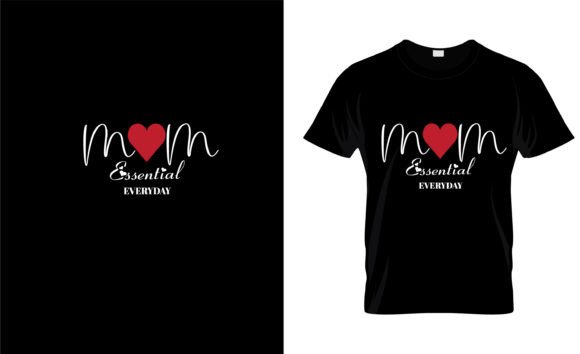
The design reads as friendly but intentional—no excessive swirls, no fragile serifs, no tiny disconnected elements begging to vanish under satin stitch. The lowercase “mom” sits centered, with subtle rounded terminals and even spacing that translates beautifully into stitch paths. There’s a soft, open counter in the “o,” and the “m” has just enough weight variation to avoid looking flat when filled. Because it’s delivered as AI, EPS, PNG, and SVG files—all CMYK and print-ready—it’s clearly meant for both digital prep and physical output. But what matters more for embroidery is how those vector curves behave when converted to stitch files: they’re smooth, scalable, and free of unnecessary anchor points. That means fewer jump stitches, cleaner satin edges, and less risk of puckering on curved surfaces like caps or pillow covers.
Where Mom Everyday Shines (and Where It Needs Thought)
This design thrives in projects where sincerity outweighs spectacle. Think: embroidered baby onesies (tested on 100% Pima cotton—held up well with tear-away + lightweight cutaway), personalized aprons for small-batch bakeries, or minimalist patches sewn onto denim jackets. On a medium-weight fleece sweatshirt, the letterforms stayed crisp at 3.5" wide—no fill-stitch bleeding, no legibility loss in the inner curve of the “o.” For holiday embroidery—say, a linen stocking or a wool-blend blanket—the clean lines keep it timeless, not trend-bound.
But let’s be practical: Mom Everyday isn’t ideal for every surface. On thin, stretchy jersey t-shirts? Proceed with caution. Without proper stabilization and careful hooping, the open negative space between letters can distort. On dark fabric, test your thread contrast first—especially if stitching over black or navy; light grays or creams may disappear unless you add a white underlay. And while it scales nicely down to ~2.75", I wouldn’t push it below 2.25" for machine embroidery—tiny terminals lose definition, and satin stitch density becomes harder to manage without thread breakage or skipped stitches.
Real-Life Fit: From Craft Fair Booth to Etsy Listing
Last month, I used Mom Everyday to create a limited run of embroidered canvas lunch totes for a local preschool fundraiser. We paired it with a simple leaf motif (added manually) and stitched it on the lower left front panel—just above the seam. Customers responded immediately: “It feels handmade, not mass-produced,” one told me. That’s the quiet strength of this design. It doesn’t scream “gift”—it whispers “thoughtful.” That nuance matters for Etsy sellers and small shop owners building brand consistency around authenticity. As a digital embroidery file, it’s easy to modify: swap fonts for monogram integration, adjust letter spacing for curved cap fronts, or layer it subtly behind an applique heart for nursery decor. Just remember—since it’s delivered as vector assets, you’ll need to digitize it properly for your machine. Don’t assume the PNG or SVG is stitch-ready out of the box.
Design Integrity Meets Commercial Practicality
What makes Mom Everyday work across so many use cases isn’t just aesthetics—it’s structural honesty. There are no hidden traps: no overlapping vector paths that cause double-stitching, no ultra-thin strokes that vanish at low stitch density, no gradient fills that don’t translate to thread. That builds customer trust. When someone buys a handmade product featuring this design—whether it’s a custom embroidered pillow cover or a boutique-branded tea towel—they’re getting clarity, not compromise. And for craft business owners, that consistency supports repeat purchases and word-of-mouth referrals.
For commercial embroidery, the lack of dense fill areas means faster run times and less wear on needles—especially helpful when producing bulk orders for baby boutiques or wedding gift sets. As a T-Shirt Designs asset, it avoids the common pitfall of looking “designed for screen print, not stitch”: no fine halftones, no micro-details, no reliance on color blending that embroidery can’t replicate. It’s graphics with embroidery intelligence baked in.
Essential Designer Notes Before You Stitch
- Always test on scrap fabric first—especially with textured weaves (like burlap or terry cloth) or high-loft fleece.
- Check thread color contrast on both light and dark backgrounds before committing to a full run.
- Review stitch density in your digitizing software—if it’s too high for lightweight fabrics, reduce fill density by 10–15%.
- Confirm hoop size compatibility: the original vector scales well, but your final stitched version must fit your machine’s maximum hoop dimensions.
- Inspect small details in black-and-white mockups—what looks balanced on screen may read as heavy or light once stitched.
- Use appropriate stabilizer: cutaway for knits, tear-away for stable wovens, fusible for lightweight linens.
- Verify licensing terms before selling finished items or reselling the digital embroidery file—this affects Etsy sellers and digital product shops directly.
In short, Mom Everyday earns its place in my go-to folder—not because it’s flashy, but because it’s dependable. It works quietly, respectfully, and well across baby embroidery, holiday embroidery, custom apparel, and small shop merchandise. It’s the kind of design that doesn’t distract from the person wearing it—or the story behind the gift. And in a market crowded with overly busy graphics, that restraint is rare, valuable, and deeply professional.