Crazy Proud Always Loud Hockey Mom SVG: A Designer’s Review
Every so often, a design file lands on my desktop and I immediately know which project it’s going to live on. Crazy Proud Always Loud Hockey Mom SVG is one of those. The first time I opened it, I wasn’t just looking at a graphic—I was already picturing a weathered canvas tote slung over a rink-side bleacher seat, the lettering crisp and undeniable even from a few rows up. That’s the kind of mood this design creates. It’s bold, affectionate, a little bit cheeky, and completely wearable.
I’m reviewing this from the perspective of someone who actually digitizes, stitches, and sells finished goods. I don’t care about how a file looks on a screen. I care about how it translates to thread, how customers respond to it, and whether it holds up after a dozen washes. Here’s what I found when I put Crazy Proud Always Loud Hockey Mom SVG through a real-world embroidery lens.
What the Design Feels Like Before You Hoop It
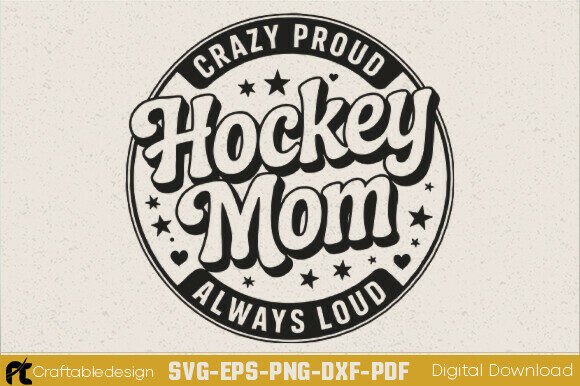
The composition leans heavily on type, which is always a double-edged sword in embroidery. The lettering is playful but not childish, with a confident weight that reads well at a distance. The phrase “Always Loud” tends to be the anchor—it’s the visual shout that balances the softer “Crazy Proud” and the identity marker “Hockey Mom.” There’s a nice rhythm to the layout. In SVG form, the curves are clean, and the paths are surprisingly well-ordered for a file that also includes DXF and EPS variations. I didn’t have to spend an hour cleaning up stray nodes before turning it into a stitch file, which immediately tells me the designer understood output requirements.
The mood is unapologetic team-spirit energy. It’s not subtle. It’s not meant to whisper. It’s the kind of design that a customer buys because they want to wear their mom identity like a badge of honor. For a craft business, that emotional pull is gold—it gives the finished product story and personality, not just decoration.
How It Actually Performs in an Embroidery Project
My test run was a 12-ounce cotton canvas tote—the kind I sell for game-day bundles and rink-side gift sets. I scaled the design to about 5.5 inches wide, which fit comfortably in a 6x10 hoop. I tried a version with a satin-stitch outline on the main text and a subtle fill stitch on the secondary words. The result was exactly what I hoped: the typography stayed legible, and the slightly condensed letterforms didn’t trap thread or distort when I used a medium-weight cutaway stabilizer.
On a pre-shrunk Gildan sweatshirt, the design felt even more at home. The fabric’s soft nap gave the stitches a slightly dimensional look, and the light gray thread I used for “Hockey Mom” popped enough to feel deliberate without overwhelming the rest of the words. Customers who saw it on my preview reel immediately asked if I’d make one in royal blue and white—classic team colors. That’s the kind of response you want: recognition that the design works as a custom apparel piece, not just a digital file.
I also tested a smaller version on a toddler raglan tee, shrinking the design to 3.8 inches wide. The lettering held up, but I had to simplify the stitch type and reduce density slightly. This is a design that needs breathing room. Tiny details, like the inner curves of the “a” and “o,” can fill in if you’re not careful with your stitch settings. I’ll talk more about that in a moment.
Where It Shines: Product Ideas That Feel Natural
If you’re running a small shop or stocking an Etsy lineup, the obvious home for Crazy Proud Always Loud Hockey Mom SVG is on a game-day sweatshirt or a rink-ready hoodie. But I’d argue the design is even stronger on items where it catches people off guard. A crisp linen tea towel with this bold statement? It becomes a conversation piece in the kitchen. A structured canvas apron for a mom who grills while the kids practice? Perfect. A simple throw pillow cover tossed on a bench in a hockey-themed basement? It sells itself.
I’ve also seen it work beautifully on a structured cap, though you have to be mindful of the curve. The design’s linear nature means it can warp on a highly curved surface if you don’t arc it slightly before stitching. For a patch, the thick lettering is a dream—it translates well to a satin border and feels substantial enough to be sewn onto a jacket or bag. If you’re thinking about personalized gifts, this design is a natural fit for a set of embroidered accessories: a zip pouch for skate laces, a coordinating luggage tag, maybe a matching key fob. The visual language is cohesive enough to build a mini line around.
When to Use Caution, Not Just Enthusiasm
I’m a realist, so let’s talk about the moments where Crazy Proud Always Loud Hockey Mom SVG might test your patience. Small hoop sizes are the first hurdle. While the files are vector and scalable, lettering-heavy designs can lose legibility when forced below 3 inches. On a baby onesie, for instance, I wouldn’t go smaller than 3.5 inches, and I’d definitely use a fine thread and a 60-weight bobbin to keep the letters crisp. Detailed corners—like the apostrophe in “Mom’s” if it were included, or the tight junction of the “y” and “d” in “Proud”—can become dense stitch areas that fray thinner fabrics. I’d avoid stretchy knits unless you’re very confident in your stabilizer pairing.
On dark fabrics, the design’s contrast depends entirely on thread choice. The file itself is a clean black silhouette in PNG preview, but when you stitch it, you’re painting with thread. A charcoal sweatshirt with a navy thread will lose the design entirely. I always run a quick black-and-white contrast test on my screen before choosing colors, and this design benefits from that extra step. Textured fabrics like terry cloth or chunky knit scarves? Maybe skip those. The lettering needs a relatively smooth surface to read clearly.
Frequent washing is another consideration. I’ve learned that satin stitches on lettering can snag over time if the finished product is tossed in the dryer with everything else. A gentle wash cycle and a low-heat tumble dry will keep the words looking sharp. For a product you’re selling, I’d consider adding a care tag that mentions machine-wash cold and line dry—it protects your reputation and the customer’s investment.
Stitch Room Notes: What I Check Before Every Run
Before I push any file to the machine, I have a mental checklist, and Crazy Proud Always Loud Hockey Mom SVG is no exception. First, I always test on a scrap of the same fabric and stabilizer I plan to use in the final product. Even if I’m stitching a dozen tea towels, I’ll run one sample to check thread tension and stitch density. With this design, I pay close attention to the counters (the enclosed spaces) in letters like “o,” “a,” and “d.” If the stitch density is too high, those holes close up and the word becomes a blob. I lighten the fill or switch to a running stitch for the thinnest parts if needed.
Hoop size matters more than you think. If you’re using a 4x4 hoop, you’ll be limited to a smaller scale, and the design may lose its impact. I prefer a 5x7 or 6x10 for this one; it gives the lettering room to breathe and keeps the proportions balanced. The provided ZIP file includes SVG, EPS, DXF, PDF, and PNG formats, which means you have flexibility in how you bring it into your embroidery software. I use the SVG for clean import, but I’ve also found the EPS version helpful for older software that likes a more traditional vector path. The PNG is handy for quick mockups or Etsy listing previews, but it’s not the file you’ll stitch from—so don’t confuse the two.
I also test the design in a monochrome environment. I’ll invert the colors on my screen to see how the design reads in reverse, which is surprisingly useful for picking a thread color that works on both light and dark backgrounds. A customer might order the same design on a white tee and a black hoodie, and you want to be confident it looks fantastic in both.
The Emotional Value You’re Buying
What I appreciate most about this design is that it isn’t generic. It’s not “I Love Hockey” or “Hockey is Life.” It’s personal, loud, and specific. That kind of specificity is what makes an embroidered product feel like a gift someone picked out intentionally, not a last-minute stall grab. I’ve had customers buy a finished tote from me and then send a photo of their mom carrying it at a tournament. That’s the loop closing: a design file turns into a stitched product, and that product becomes part of someone’s memory.
For craft business owners, this also means the design has repeat value. You can offer it as a ready-to-ship item, a made-to-order sweatshirt, or a digital download (if your license allows). The phrase “Hockey Mom” alone has proven search volume, and adding “Crazy Proud Always Loud” gives it a proprietary feel that stock phrases don’t have. I’d use it in a mockup collection for a boutique branding shoot, or as a staple in a winter craft fair lineup. The visual personality is strong enough to anchor a product photo, even without a model.
What the ZIP File Actually Contains
You’ll receive a standard ZIP with SVG, EPS, DXF, PDF, and PNG files. The SVG is what I gravitate toward for most embroidery digitizing, because it preserves layers and paths cleanly. The EPS is a solid backup, especially if you’re working with CorelDRAW or older software. The DXF can be useful for some cutting machines, but I rarely use it for embroidery. The PDF is a nice touch for a quick print reference, and the PNG is my go-to for placing the design on a digital mockup. I’d recommend opening all of them once just to confirm which works best with your workflow. Since the product description doesn’t specify stitch count or explicit hoop sizes, you’ll need to digitize accordingly and test based on your own machine’s capabilities.
Before You Sell or Stitch for a Client
One final, practical note: always confirm the licensing terms before you turn this file into a finished product for sale. The description says “Digital File,” and while many SVG designs are intended for personal and commercial use, it’s not always clear. I do a quick check on the designer’s terms or reach out if I plan to sell more than a handful of items. For a small shop product, this design is a winner, but only if you’re operating within the right permissions. Similarly, if you’re reselling the digital file itself, that’s a different license category entirely. Treat the design like a valuable asset—it is—and protect your business by knowing where you stand.
Would I recommend Crazy Proud Always Loud Hockey Mom SVG to another embroidery designer or handmade seller? Absolutely. It’s the kind of file that feels like it was made for people who actually stitch, who understand that a design isn’t just a pretty picture—it’s a promise of a finished item that someone will wear, wash, and be proud of. That’s a high bar, and this one clears it.